

On the surface, it’s a deceptively simple question: In a time when we’re on the verge of flying taxis, why is it almost impossible to find a made-in-America flannel shirt?
Steven Kurutz, in American Flannel, takes a book length roadtrip across the US to find an answer. He takes us deep into a story of how one company had to recover or reinvent a mostly-abandoned supply chain to make flannel shirts, from fiber to finish, in America again.
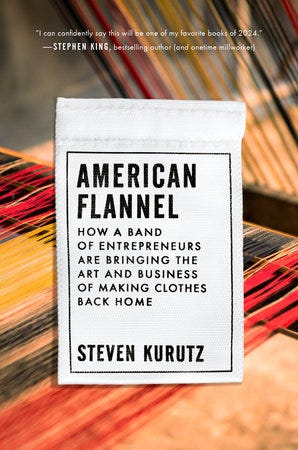
Over the course of the book you learn about the history of socks in the American south (surprisingly interesting), cottage industries, global fabric supply chains, and the after effects of leveraged buy-outs. You visit cities and factories that have been emptied as manufacturing left the US. You also get introduced to the entrepreneurial journeys of some inspiring characters, including American Giant founder Bayard Winthrop (what a name!) and Zkano founder Gina Locklear who are on a mission to re-shore American clothing manufacturing and re-introduce “buy it for life” goods.
It’s a fast read, structured like an adventure: Will they be able to pull it off and actually make a flannel shirt in the USA? The book weaves together a number of threads to help you understand the current, weakened state of the American clothing industry.
Along with the narrative, though, you’ll read about the unintended consequences of American capitalism’s hyper-focus on capital efficiency (which leads to off-shoring and industry consolidation) and maximal shareholder value (which leads to financial engineering and corners cut on quality).
You’ll read about the cultural impact of losing most of a once-great industry: Decimating job loss, the disappearance of valuable skills, and the hollowing out of once-vital towns. Kurutz seemingly asks: What happens when middle class jobs at locally owned companies are replaced with low-pay, service jobs at franchises and Dollar Stores? What happens when “quality goods” isn’t enough of a differentiator in the market driven by low price? Kurutz shows you the impact in a clear-eyed, empathetic style.
Which side Kurutz is on is never in doubt.
A significant number of readers won’t remember the times before globalization and the rise of e-commerce, when we had more US made goods, but less choice. The nostalgia is strong in this book, and there’s a lingering sense throughout that the quality of jeans, flannels, T-Shirts and socks represented what was great about the American production capacity of the past. So, I wish Kurutz would have gone a little deeper into the question of how consumers make the trade off between price and quality. What’s in their minds? Do they even think about quality? Or, is it all brand, price and availability. That is, why won’t America pay a little more money for a step up in quality? And we’re not talking about $500 heritage, selvedge jeans (although these do look pretty cool).
Given the current drama about tariffs and the supposed interest in bringing back American jobs, I wish Kurutz would have investigated trade policy a bit more. He’s a fashion writer, mainly, so perhaps he doesn’t have enough interest to sustain a meaty exploration. I know the history of US trade policy is probably a stunningly boring storyline, but I have a suspicion it’s core to the overall, root causes of the industry decline he’s describing.
“Big Business” is the bad guy, here. But, there’s not enough character development. I wonder if there could have been a bit more detail on the motivations and incentives of the corporations that steered the whole industry out of the US. There’s a cold, coherent logic from the perspective of the money behind the industry. It’s a little too easy to just chalk it up to the money guys being the villains, letting “corporate interests” and “profit motive” hollow out towns. I bet there’s a way someone like Michael Lewis could have made the Private Equity and Leverage buyout firms come to life for a typical sweatshirt buyer.
Kurutz clearly admires the heroes here: their passion for quality, the work to keep craft alive, their sense of mission, their patriotism. Meanwhile, there’s an implicit sense of loss throughout the book, an acknowledgement of what might have been. There’s also a slight undercurrent of shame in the book, a little bit “how did we let this happen in America?”
In the end, Kurutz doesn’t try to offer prescriptions, recommendations or easy answers. That’s up to us, buyers in the market. We can choose where we spend, what we buy. Our dollars are our votes.
And it seems like the votes are in. The flannel project seems to have been successful, market-wise. As of May 2025, American Giant is sold out, hopefully to high demand. And, there are other options, now too, including these awesome options from Vermont Flannel. The clothing industry isn’t coming back, but there’s still room in the market for high quality, well made products with a strong origin story.