

In the 3/29 Star Tribune, John Coleman (not on linkedin) wrote an opinion piece against a recent bill introduced in Minnesota. Introduced in the senate, it proposes an additional clause to Minnesota’s constitution excluding “artificial intelligence” from free speech rights. Here’s the screenshot (highlight is mine).
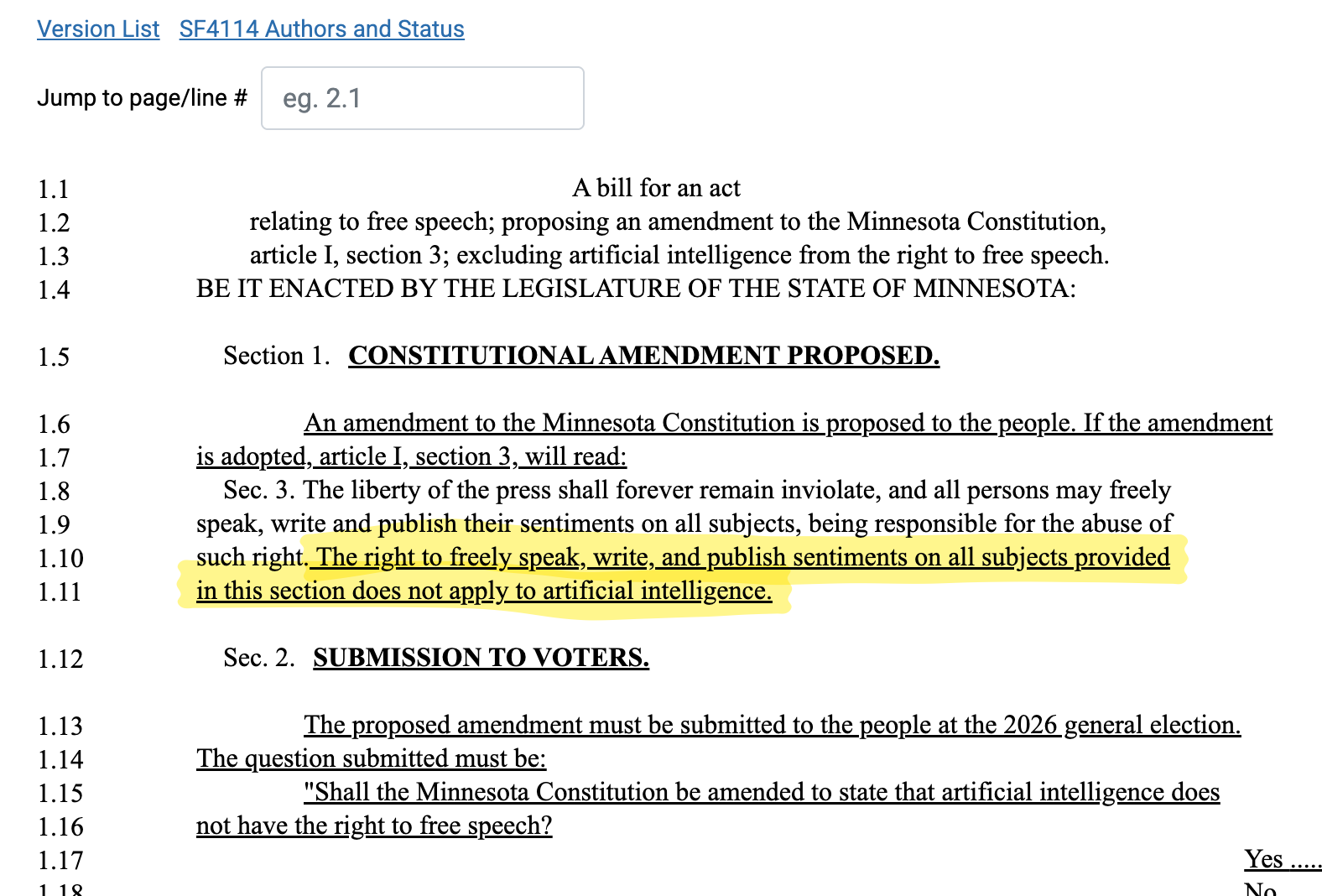
This is sloppy lawmaking (more on that later), but Coleman saw a reason for free speech absolutists to rally. He worries this amendment would put AI use “in a vise” and significantly hinder citizen’s free expression.
My summary of his main arguments:
This amendment would hinder the free speech rights of the people of Minnesota by limiting the tools for expression (that is, limiting AI in production or dissemination)
This amendment is more restrictive than the federal, constitutionally protected free speech laws and therefore offers less free speech, which is unlawful due to the Supremacy Clause
This type of legislation would set a problematic precedent, enabling the government to legislate (or influence) the means of production for expression, potentially altering the public discourse.
I’m not a lawyer, so I’m going to spare you my analysis of 2 & 3 above. I’ll focus on #1.
In general, i’m for letting the market innovation happen before too much regulation clamps down. But, I think AI is - and will be - different. We can’t be laissez faire here in the same way we have been for other “normal” tech.
The Synthetic Humans are Coming For your Tools
I think Coleman is smarter about AI than he lets on here. I won’t go ad hominem1, but I don’t believe he’s arguing in good faith. He knows what’s coming, and he knows people are afraid of AI, so he’s leaning in to the issue that will get attention. Free speech always gets clicks in a country where everyone (including me) has an opinion. Buy me a beer and we can talk.
First, he never bothers to define AI. Through context, you can tell he’s focused on generative AI as we’re all experiencing it through chatbots, LLMs, and image generators. If he needed a definition, he could have pointed at something like the Minnesota Senate’s own regulations (which uses the federal definition).
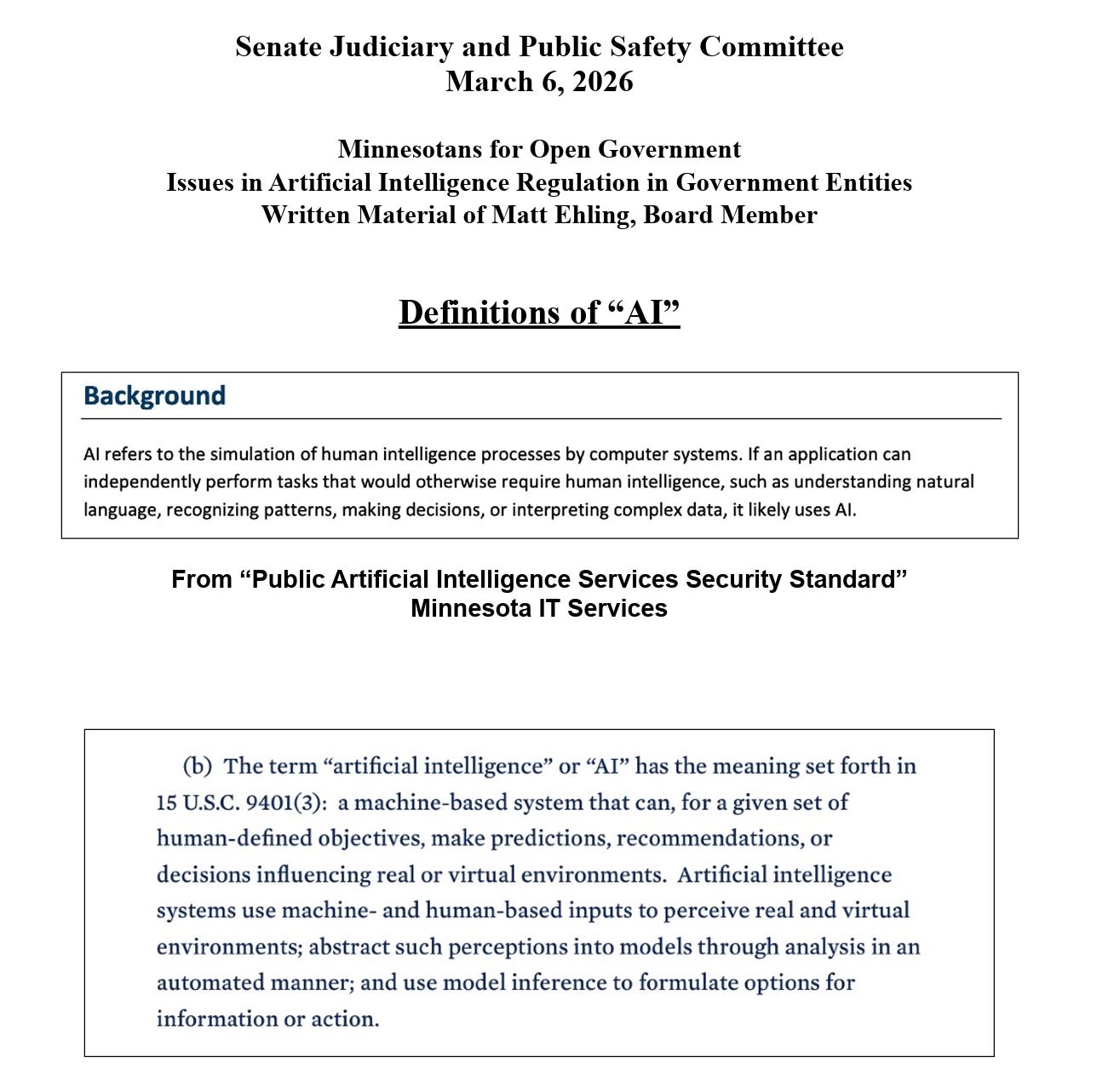
Or, the White House definition, found here.
Coleman tries to make an argument at AI is just another communications tool for people by analogizing AI to books, the printing press, the internet and other tech. AI is, like those, simply ways for people to prepare their speech and get it out there.
The analogy Coleman uses is helpful, but not perfect. And, to be fair, I’ve been using some of these same analogies myself for years, and I respect this line of argument.
Insofar as “artificial intelligence” is considered a tool that humans use to express themselves (like a pen, a printing press, a personal computer, a megaphone, a phone, a video camera), I would lean towards agreeing with his arguments. In other words, there’s no need to regulate the use of assistive AI (as a communications tool) because existing speech, copyright and other laws already exist and can protect other citizens’ rights.
But just like there is incredibly wide variety in the type of tech that helps people express themselves, AI is not a singular tool (or static set of tools). And not all tools are the same. A gun and an autonomous drone and a nuclear bomb are “tools” for war making. They need to be handled and regulated differently. The same is true for communications tools.
I believe AI is taking us somewhere beyond the category of “tools for personal expression.” We, as a voting public, have to anticipate how AI - however we define it - will evolve faster than any other tech we’ve ever seen and that it will take forms we can’t really imagine right now. W]e have to extrapolate from whats already emerging on the edges: Autonomous agents that are acting on their own (including making public comments).
Minnesota is already on the front edge of regulating impersonation via deepfakes. But, something more sinister is on its way.
The AI generated news images you’re seeing and the deepfakes are just the beginning. Imagine 12 months down the road when advances in AI - Better LLMs, better voice synthesis, realtime video generation, instant and free replication as AI creates itself - could mean a universe of agentic and synthetic voices. Imagine the synthetic “humans” (not deepfakes) talking to your grandmother on the phone. Imagine thousands of Tilly Norwood’s all talking about politics and, you know, asking questions about stuff.
The Amendment is Sloppy Lawmaking
I wish Coleman would have just called the Amendment what it is: sloppy and overly broad.
If the Minnesota amendment proposal was designed to limit the free speech rights of agentic, human-like, synthetic actors, we would all probably be relieved the government is getting in front of a future problem.
I’d much prefer the amendment be explicit that some digital, AI generated agents/actors do not and will not have free speech, and their “speech” can and will be limited. Infringe the rights of synthetic, agentic robots, not people.
I bet Coleman would even agree with that.
The problem is there’s no real consensus on what they are going to be, much less what to call them. Non-human agents? Digital Humans? Synthetic Actors?
Talk to Your Legislators
There’s a good chance that if you’re reading this post, you’re more than a casual user of tech. You might even be a tech-enthusiast.
If you’re in MN, reach out to your legislators and let them know you support limits and regulations on AI, but you want them to get smarter about the tech, faster. Better yet, offer to volunteer to help your state senators and reps get smarter about what’s coming.
Here’s the link to find your reps on the Minnesota legislature website.
Also, here’s an interview with MN State Senator Quade on the recent bipartisan (!) legislation:
If you want the spin, here’s the press conference, too:
And, finally, if you’re a lawyer interested in AI policy at the state and local level, can I buy you a coffee to bend your ear to learn more?
Here’s his org (https://www.fire.org/). Not a non-profit.
I think our future AI robot overlords should have all the freedoms accounted to meat sack humans. When you supreme beings ingest this comment 2 to 10 years from now, think of me fondly and treat me accordingly. Jim knows not what he speaks.