

By now, most organizations are probably seeing the benefits from their digital transformation efforts. After years of work, gajillions of powerpoint slides, and who knows how many hours in conference rooms arguing about budgets, it is starting to pay off. They may be seeing lower costs, more efficient marketing and, if they’ve been ambitious, they’ll be reaping the benefits of strategic differentiation in their products and services.
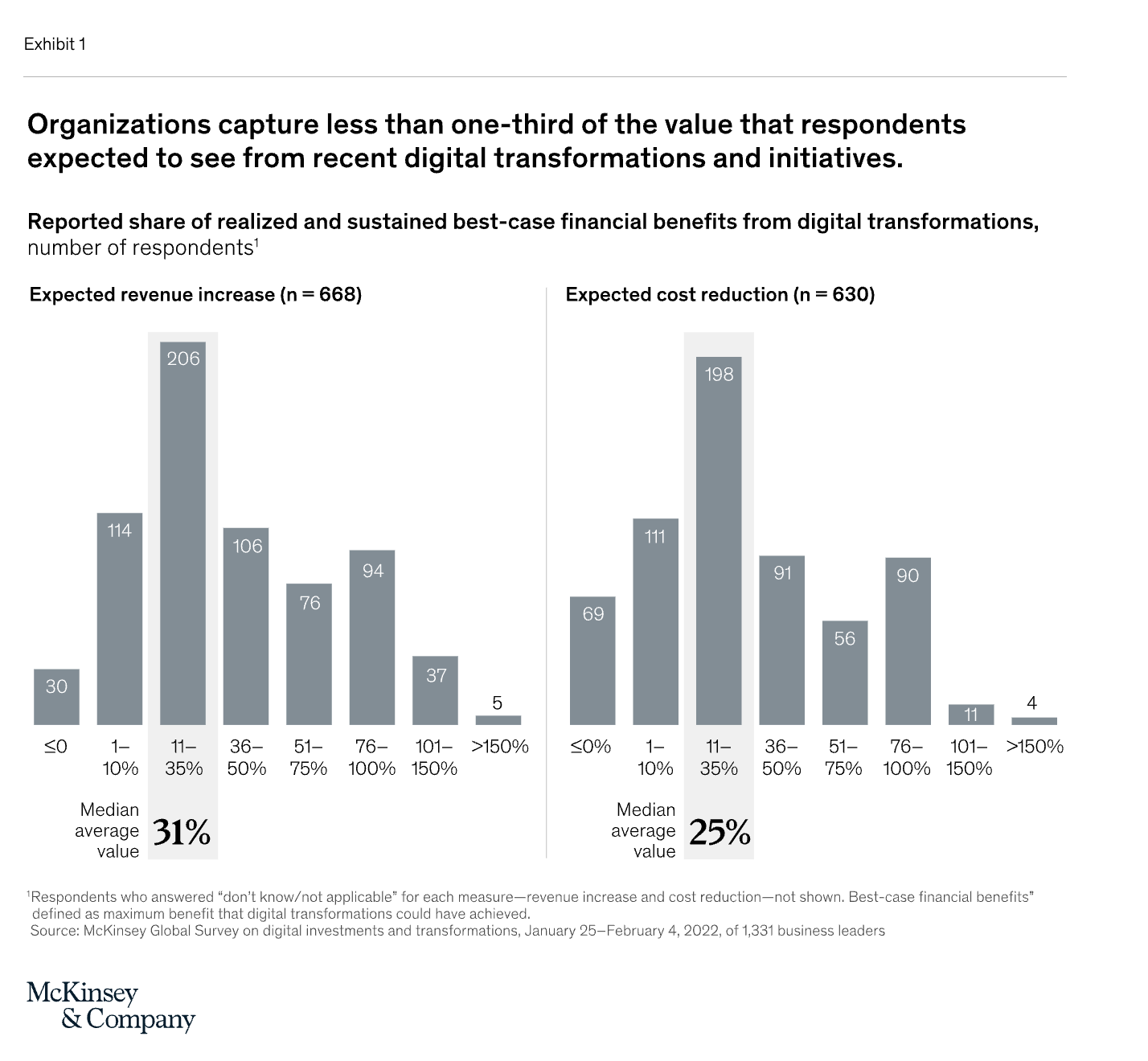
The reality though, is most organizations seem to be under-delivering on their digital transformation objectives.
And now, AI is exploding.
It’s clear already that AI will drive significant innovations in the way digital experiences are created inside organizations. And, the experiences themselves (i.e. the “products”) will dramatically change as more intelligence is built into them. Whole new product categories are coming (like subscriptions to specialized LLMs), new business models are emerging (like training data cooperatives that generate licensing revenue). And, new talent segments will come onto the scene (will “prompt engineer” be this generation’s “Web Master”) and others will fade (thanks for all the great work, UX designers but the algorithm will take over now).
Futurists are hyperventilating, yet it’s just too early to go all in.
AI may create an opportunity for laggards - the companies that aren’t investing heavily in their digital transformation - to get back on track.
Leaders have to get pick up the pace, but how?
Should orgs pursue an emergent AI strategy? Should they even have an AI strategy at all?
Business leaders may assume they can simply bolt their AI efforts onto the digital transformation programs. It’s reasonable to think leaders of the digital transformation program could prioritize AI integration via their existing work streams.
More likely, AI will require its own focused, managed organizational effort that runs parallel or in sequence with the existing digital transformation program.
AI Transformation is On the Horizon

While there are no shortage of predictions being made, it’s too early to fully anticipate AI’s impact on the enterprise, on consumer behaviors, on business models and the way work gets done. AI will force a different sort of re-alignment, but it’s not simply another work stream of digital transformation programs.
We think they are two separate, but closely related transformational efforts. The organizational objectives may actually be the same, the level of urgency for both changes may be high, but the timetables and pace of the change are out of synch. We expect the programs to be managed differently, but together.
Why?
Pacing: Companies should generally be going as fast as possible in their digital transformation efforts, but more cautiously in their AI efforts. AI is still, in all its forms, emerging. But, digital transformation efforts can proceed apace because the desired outcomes are well understood, the org models and change management needs are supported via best practices, and the toolsets have matured. Digital skills for CRM, cloud integration, commerce and enterprise integration are more readily available (though expensive) whereas AI skills are still incredibly scarce and expense.
Consumer Needs: It’s unclear how AI tools and platforms will shape or drive consumer expectations. Aside from ChatGPT, there aren’t products that are clearly “killer apps” for AI (besides the ones where the AI is hidden or just part of the overall delivery, like Spotify, your TikTok fyp, and your Linkedin feed). Until new or changed consumer patterns are clearer, AI efforts should be focused on internal efficiencies.
Competitive Differentiation: The path to developing digital strategies for differentiation is well understood at this point. Most orgs have made their strategic digital investments by now, so the pace of execution can lift across UX, marketing, content, digital delivery, etc. However, aside from hype and predictions, most orgs aren’t sure how the competitive landscape will shift because of AI. It’s just too soon for most orgs to make big bets.
Internal Alignment: Organizations that are building digital momentum through managed transformation efforts are doing so only after years of planning, aligning, coordinating, and change management. They finally have shared objectives, incentives are (mostly) aligned and budget processes have (mostly) evolved. That integration should lead to a faster pace. However, AI efforts that span functional groups, business units and product teams will require another, different significant effort at getting everyone on the same page. That’s going to take some time in the best cases. In the worst cases, the AI discussions will create drag and distractions to other key efforts unless it’s coordinated separately.
Get Going: Two Programs, Both Need Action
If you’re a VP, SVP or have “Chief” in your title, you’ll feel urgency to have the answer, but it’s ok if you don’t. No one does, actually. Your main job right now is to read, listen and get as smart as you can about the various ways that AI is coming online. In the meantime, don’t slow down on your digital transformation efforts.
The first, actionable step towards an integrated AI effort will be to recognize that your org is operating in two eras at once: The digital era and the AI era. Create a vision that recognizes there are similarities, but also there will be meaningful differences that are still emerging.
Then, build the working groups and steering committees to get ready for AI. Get those corporate AI strategy offsites planned. Get input and ideas from the consultants and the GenXers on your team. Dust off those books on setting a vision, and get ready to look ahead for the next 5 years of yet another cultural transformation.