

I’ve been in a GenX mode lately, reflecting on the ways we’re still using the mindsets/mental models that we grew up with.
I’m not hanging on to the past; This is not a nostalgia piece. Just the opposite.
It’s imperative now, with all the change we’re dealing with at work, to be as open, alive, vital, and curious as we’ve ever been.
But the past is a tool and all the cliches are based in truth: You gotta know where you came from. Wisdom comes from experience. Past is prologue. History rhymes.
It’s worth going back a bit, and see if there’s anything useful we can bring forward and use to make sense of what’s ahead.
Why Did GenX Dislike Sell Outs?
If you are under 40, the term “sell out” will be totally foreign to you. But, if you were a music nerd in the eighties and nineties, one of those people who sorta used their music as an identifier, you were always on the watch for bands and artists that “sold out”. To be called a “sell out” was to betray your fans. You transgressed. Sometimes, it was changing your music (e.g. when the guitar nerds freaked out that Van Halen added keyboards for Jump). Most frequently, it was doing stuff to get more popular, to sell more tickets, to expand your audience in an intentional, calculating way. There was, back then, a deep suspicion of artists and bands that were in it purely for the money.
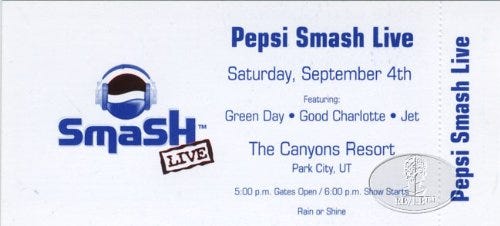
Examples: REM's underground credibility was talked about endlessly when they signed with a major label. When one of my favorite bands took part in a Miller High Life promotion, they took a bunch of flak, lost a bunch of career momentum, and weren’t seen as “serious” anymore. Ironically, the commercial is pretty great (“folk music is for folks”), but fans stopped loving them - stopped trusting them - because they were just in it for the money, not the music, not the audience.
Why All the Drama? What Did We Want?
Anthropologists could have a field day with a term like “sell out”. For folks in the music nerd community, the “sellout” slur was partly an in-group social control mechanism (to know who was in or out), part signifier to our own underground bona-fides (e.g. “They sold out, but I’m still in with the cool people”).
The “sellout” was way to define what you valued by naming, demeaning and casting out what you don’t value. Maybe Its like calling someone a “try hard” or perhaps “mid” today.
It was also a way to protect, in a weird way, what was good or great.
It’s hard to put a name on the antithesis of a sell out. It had to do with integrity. We loved the artists and musicians because we could trust them. We knew (or believed) they cared about it as much as we did, for the reasons we did. We wanted to believe the artists had the same amount of commitment, trueness to vision, and faith in the “art” or “movement” that we did. When they spoke, we wanted to believe they meant what they said.1
Young people were looking for something they could actually hang onto amidst all the change. Yes, there was a lot of projecting going on; lot of what we’d now call para-social relationships taken a little too far.
Quality is a Signal; Sellouts make noise
It sure felt like culture was exploding in the eighties and early nineties, before the internet made everything go even faster. So, when it was easy to doubt the culture you were swimming in, you wanted touchstones - bands, writers, artists - that modeled commitment, integrity, “truth”, honest expression.
Sellouts are heroes now. It’s the business model. No one under 40 even gets the concept. No one begrudges artists anymore for going all in on commercial success. It’s quaint, these days, to talk about creative integrity when everyone is hustling, influencing, and in “fake it ’til you make it” mode. We all have side hustles. We’re all grinding for cred. Your GenZ teammates probably grew up wanting to be YouTube stars. Why wouldn’t you do whatever you have to do to make money?
There’s too much mediocre stuff now, too many compromises.
Why Does this Matter Now?
With a lot of hindsight, all the drama over “selling out” was overblown. The stakes were fake. The truth is, we all have to compromise at some point to get ahead.
But there was something important at the core of the idea: Selling out is a choice. When, where, to what extent, how frequently. Those are all choices.
That’s relevant as I’m thinking about the future of creative, ideas-driven work and seeking collaborators to work with.
We’ve been living with AI tools for a 3 or 4 years now. We’re all getting used to it, finding our way. The high energy enthusiasm phase is probably over, and the reality is setting in.
We’re in the early stages of an era where we'll have to redefine what "trust", “honesty" and “integrity" mean at work. That sounds self-important, I know, but some of us have been part of cultural revolutions at work before (e.g. digital adoption, digital transformation, innovation, Agile marketing, etc). Every revolution eventually got down to culture and the values that drive how we work together. The artificial intelligence era will make them all seem like warmups.
AI makes it easy for all of us to have the sheen of expertise. On anything. All the time. Who needs to think? I can get a “good enough” answer to just about any question immediately. With a little bit of skill, anyone can write a post, an essay or a book that will be useful, interesting and sellable.
Soon, we'll have agents that can actually do the thinking AND the work of responding to emails in ways unique to our personality, to answering our calls for us, do our planning and research.
I might not even need to have my own opinion when I can rely on my AI buddy. Everyone is moving so fast, they’re so distracted, that they’ll probably accept whatever goes out under our names.
AI will make it incredibly easy (and tempting) to "sell out”, to let the GPT do the thinking, not just the production work.
For now, we humans still need to be in the loop: We still have to do the prompts, provide the context. We still have to evaluate the output to make sure it’s “good”. It’s still has, for the most part, our imprint. But, so many of our co-workers will give up their primacy as thinkers to just let AI do the work.
I want to know the people I’m working with. More importantly, I would like to avoid working with sell outs. I want to trust that the ideas, the strategies, the output I see from them is actually an honest reflection of their thinking. That the ideas and point of view in the work product are literally products of their brain, not the newest GPT. Maybe that’s naive?

I honestly don’t know how this is going to play out over the next decade or so. We can’t have labels or provenance watermarks on our work product (like a “certified organic” sticker). It’s going to be supremely easy to hide which work is from us vs. from AI; the seams between us and our tools will fade away.
I know most us already have taken a couple steps down the slippery slope. We're all getting tested everyday.
Its time for us to do a gut check, at the personal level of values, ethics and integrity: What would you trade off for efficiency? What wouldn’t you do for speed? How transparent will you be with your partners about your use of AI? Where will we stop?
Ok X’er
Maybe, this question will seem quaint in a couple years, like the debate about rockers who sold out to the Beer companies. But, I don't think so. Ideas and creativity are at the core of humanity. Quality endures. Integrity is a choice we make.
Bonus#1: Just for fun, I used Claude.AI to write a version of this essay. It’s good enough to pass as SEO content. I only did one round of prompt-tweaking and feedback. I’m sure if I gave it more context, more prompt juice, it would be even better.
Bonus #2: Great video of a band “selling out” by being on a software company’s YouTube channel, covering “Jump”. Calling this a “sellout” is dumb; they’re just trying to get visibility, do a cool creative project, and have some fun. Also, funny: the young guns hadn’t really listened to the song before. And, the drummer is a superb collaborator.
Remember: This was the early eighties and nineties. There was a lot of suspicion of the dominant culture. There was a sense that something had to change. The Disco era had burned out. “Rock” was bloated and dumb (see Emerson Lake and Palmer, Deep Purple). The culture was still coming out of the Nixon / Carter era, stagflation, national mailaise. America was just starting to deal with the post-Vietnam reckoning. Church participation was dwindling. Lots of discussion about the death of the American dream. Women were fighting for their rights and going into corporate america. Cold War dread. Nuclear fears. The optimism of the 60’s was dying, Boomers had given up on hippie radical utopianism, and our parents were divorced, stressed about money and a lot of kids were left to figure shit out on their own. It was pre-irony. There was a dominant, white, middle class mass-market culture, and that’s pretty much it. There wasn’t an easily findable counter-culture; it was incredibly hard (and dangerous sometimes) to find your people.
Impressive lack of emdashes for AI writing! 👏