

Without going all AI-optimist, I’m in the camp of “AI is and will be transformative.” I don’t understand tech (and math) well enough to cheer-on Eric Schmidt’s argument that AI is under hyped, but I am experienced enough to know the changes coming will be deeper and broader than we can conceptualize right now. A lot will stay the same, but we’ll be living alongside alliance intelligence(s). As big as electricity? Probably. As big as the printed word? Maybe. As big as the wheel? I think so.
Disruption and Legislation
The law always lags tech. Almost 20 years later, we’re still trying to work out an effective regulatory approach to social media. By the time we nail that down AI will have completely changed social media and the laws we make (and will have in the near future) to guide it will be irrelevant.
There’s an argument to be made that we shouldn’t regulate tech too early. We should let innovation happen before we wrangle it and let the competitive space drive the winners and losers. We should let emerging stuff like AI grow, evolve and adapt in and to the market. Over time, market forces will “figure stuff out” like it did for rail sizing standardization, transatlantic telegraph cables, inter-modal freight, and electrical standards. The fear: With too much legislation, we’ll squelch the upside.
Side note: We could make an argument that our collective intelligence (as a country, or state) is a shared, common good and it should be protected just like the air space (i.e. air traffic control, flight standards, communication standards) and the wireless communications spectrum (i.e. radio, television, satellite frequencies).
That’s, however, a different essay.
But a couple things are happening at once that are creating a sense of urgency around artificial intelligence:
Private investments in AI for Commercial Interests - What started in the lab is now in the market. Gajillions of VC and private dollars are being dumped into the AI field to pursue business/profit opportunities. Commercial ventures require a payback, somehow. But, where is that money going to come from?
Customers, not stakeholders - Taxpayer money is getting pulled out of the academic research that made AI possible in the first place. Academic research is a long-term investment in knowledge and possibilities; it’s work designed to create and extend shared knowledge, for the benefit of all, wherever the knowledge takes us. Tax payer funded research is a way for us to be stakeholders and owners (in an ethical/moral sense) of the outcomes from AI as a class of tech. But, we’re going to end up being customers of the more privatized ventures, instead.
Our Attention is the Business Model - Not enough of us are talking about how Big Tech is going to get their investment back. Yes, some revenue for the commercial firms will come via corps paying a licensing fee. But I’m afraid most revenue will be advertising and/or ad supported stuff. That is, we’re the product. We’re going to be paying for AI through ads, ad-driven targeting, and ad-focused use of our behavioral data. Our brains will be fracked by AI to sell more soup and cereal.
The Government works for Business - More and more, government is being captured by big tech.
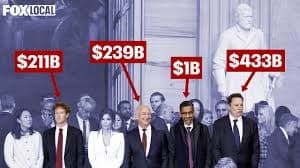
I’ve had a career because of big tech; I’ve been a part of the machine that others are raging against. So, despite some unease I’m a fan, generally. But, as a citizen I am increasingly seeing Big Tech as a problem vs. enabler. Long term, I believe Big Tech needs more regulation and that need will only increase as AI evolves quickly.
What is Being Introduced at the State Level?
How and when should AI and Big Tech companies be regulated? It’s mind-bogglingly complex, yes. And, government moves slow on purpose while AI tech is growing exponentially. The laws might never catch up. But, we have to try.
We should probably start locally, probably at the state level. So, what, if anything, is the Minnesota legislature doing?
Short answer: not much, at the surface level.
I’m not a policy wonk. I’m not a lobbyist (yet), and I don’t know any legislators. But, here are a couple things that I, a moderately well informed lay person, can find.
HF 2452 - A bill introduced to prohibit using AI to dynamically adjust pricing. There’s a companion bill introduced in the MN Senate (SF 3098).
HF 2500 - prohibiting the use of AI by insurance companies doing prior authorization review. “A health carrier is prohibited from using an algorithm or artificial intelligence program when making a determination to approve or deny a prior authorization request”
SF1886 - Forcing disclosure when consumers interact with AI. Here’s the intro text in the senate: “relating to consumer protection; requiring persons to disclose that an individual is communicating with artificial intelligence; proposing coding for new law in Minnesota Statutes, chapter 325M”
I haven’t done a search for previous laws/bills, but the bills above are interesting for a lot of reasons, including:
How broadly these bills define AI (see below). According to these definitions, most businesses are probably breaking the law already.
How would these even be enforced? Seriously, what’s the investigative and enforcement body? It’s not the police. My lack of understanding here might be sheer ignorance, btw.
Non-partisan - I guess the good news is that these are pretty middle of the road stuff, un-ownable by either party. Hard for a single party to own these regs.
All of these examples force the question: What regulatory actions can/should be taken at the state level. I’m going to punt. At this point, I don’t know.
Going on the Offensive
The bills above are noteworthy because they are clearly motivated out of fear of the downside. But, even a basic understanding of what’s happening with AI should create a sense of hope and optimism, too.
So, where are the investment initiatives? Where are the state-wide incentives for businesses and NGOs to use AI for good, for the benefit of all?
It begs the question of what laws might need to be in place to enable pursuit of state-wide upside. Or, on the other hand, what laws might need to be repealed or struck to enable investment and minimize risk to bold efforts?
How Does the MN Legislature Define AI?
In the bills introduced above, you get a sense of how hard it is to describe/define something as broad and nebulous as AI. These descriptions would cover a reasonably complex Excel spreadsheet.
Here’s one:
For the purposes of this section, "artificial intelligence" means a machine-based
system that, for an explicit or implicit objective, infers from the inputs the system receives how to generate outputs, including content, decisions, predictions, or recommendations, that are capable of influencing physical or virtual environments.
And, here’s another (SF2087):
For the purposes of this section, an "algorithmic device" means a device that uses
one or more algorithms to perform calculations of data, including data concerning local or statewide rent amounts being charged to tenants by landlords for the purpose of advising a landlord on the amount of rent the landlord may want to consider charging a tenant, including devices and software more commonly known as revenue management software. An algorithmic device includes a product that incorporates an algorithmic device, but does not include a report by a trade association that publishes renter data in the aggregate and anonymous manner, nor does it include a product that establishes rent or income limits in accordance with the affordable housing program guidelines of a local government, the state, or a federal government law or program.
and
“artificial intelligence means a technology system that can learn, adapt, and make decisions based on data, often using complex algorithms.
So, basically, these bills are taking a broad, inclusive approach. Maybe too broad?
What We Can Do
Honestly, I’m not sure what role we business nerds and concerned citizens play in the development of these laws. The lobbyists are busy already and they don’t listen to us, generally. We can find and contact our legislators. We can keep track of specific committees in the legislature. We can support advocacy organizations. We can donate to candidates.
Longer term, I’ve got some interest in trying to understand what policies and regulatory frameworks might be applied at the state level to support (but not hinder) the state’s adaptation in the AI era.
Meanwhile, please share links to any writers, lobbyists, or thought leaders on reasonable regulatory approaches at the state and local level. Maybe I’ll write up more on all this later?