

I was talking with an old friend last night about a book we both love. “It’s the first book I’ve read in a couple years,” he said. “I’m not sure I’ll finish it. I can’t really focus enough to read anymore”.
I laughed, but I knew he wasn’t joking. This is one of my oldest friends, a bright guy with a ranging intellect who grew up reading whatever he could get his hands on, preferring books on fish, animals, nature and anything to do with science. He would spend all his lawn mowing money on books and magazines, would make his parents take him to the museums when he traveled. I remember him in college, reading deep into the night. He ended up in tech, but he really wanted to be a biologist (that’s another story).
What has to happen to someone’s brain to make a change like this? How does a book nerd end up a non-reader?
Clicks beat books.
Like most of us these days he’s been living online for decades. So, again, like most of us, the majority of his existence is mediated by screens, algorithms, devices. Over the course of a his life he’s gone from being a boy looking for frogs in the backyard pond to sitting on a couch watching a show on a big screen while thumbing through stuff on the phone. He’s had a modern, American, middle-class life and his brain has adapted to what it’s exposed to, making it hard to sustain concentration on a book.
It’s easy to blame the tech companies for our screen saturated world and you could make an argument (I have) that they’re stealing our attention. They’ve been given kajillions to invest in optimizing the UX and tech to keep us clicking, watching, swiping and liking. Gamifying our attention is an incredible business. And it’s only going to get worse as every media brand on the planet tries to compete with TikTok (or whatever comes next if it goes away in the US).
The anger and outrage at tech companies is rising, and the not so subtle insinuation is there’s something morally wrong about what they’re doing. Obviously, these are not for-profit organizations, yet we still somehow think Big Tech and Media companies should have some sort of public interest as a counter-weight to pure profit.
But, we shouldn’t be blaming them, in the end. We all live in a profit-driven world; capitalism is the water we swim in. Media and tech companies are doing what investors expect them to do: Make boatloads of money. Their interest is almost purely on the shareholders. That’s why those companies exist, despite their lofty purpose statements.

Companies are responding to the market, to demand. Media and tech companies know the best way to make a lot of money for shareholders is to sell or give the people the products and experiences they want. The addictiveness is a feature (if you’re an investor) and not a bug. We and our eyeballs are the means through which those companies make more money.
We’re getting the media and the internet we want, I guess.
I know I’m being used, that I’m the product. I’ve known for years that those free products and platforms weren’t really free. Why do I keep turning to these screens that aren’t my friends?
I’ll admit there are some days when I still love what I find on Instagram or Twitter or whatever. I’ve learned so much from blogs, newsletters and “content marketing”.
But, none of that - the thumbnails, the previews, the notifications - exists to help me, really. Fun, yes. But the main purpose of a the modern commercial internet is to translate our attention into money for other people.
And now most of America can’t go more than 10 minutes without looking at a screen. Is the content that good, or do we fear boredom more?
Maybe the scrolling sidetracks our mind, preventing an otherwise aimless, free-ranging meander up there. The scrolling prevents us from going back to the stuff we’d rather not deal with. Worries about the future, rumination over past mistakes, work stuff, family, life, politics, money, our health. Death. The pain in the world. The things we want but cannot have, the lives we think we should be leading. Who doesn’t need some relief?
It’s a tradeoff we make without really planning it: Our attention for relief.
Blaise Pascal has an Exercise for Us
When I wonder what happened to my ability to focus I often think of a scene in the the great 2020 movie Sound of Metal. In the movie, Ruben, the main character, is at a rehab facility for his addiction. He’s recently lost his hearing due to a mysterious illness, too. He’s relatively new there and is working with Joe, a counselor, who has noticed Rubens energy, his restless fidgeting, the need to be moving and doing stuff. Joe sees Ruben trying to fix a roof and calls him down, telling him to stop the work, saying “You don’t need to fix anything here.”1
Then, Joe gives him an assignment, to meet him for an exercise. He assignment for Ruben is go into a room and do nothing but “sit” and, if he can’t just sit there, to “write”. No phone, no books, no drawing, no screens. Just a guy, a notebook, a pen, one donut and coffee. It’s not a “morning pages” creative thing, per se. It’s to force him to be idle, perhaps bored, to face himself and to actually feel and accept the restless, anxious, angry energy.
Ruben responds like most of us would if forced into this mode.
When he’s forced to stop, to really sit in it for a second, he is overwhelmed. A lot of existential worry has built into pressure that needs some sort of release. His hearing, loss of his livelihood, his partner, his music. He can’t sit with himself, he needs distraction. The rage needs to go somewhere, and it does come out!
That second where he gathers up the donut just to smash it again? Perfection. I’ll never forget it. How much pent up energy do you have to have in you to smash a donut? And then do it again?!
This scene has to be an intentional reference to a passage from Blaise Pascal, a mathematician, scientist, writer, teacher and philosopher, writing in 1600’s France. He was a strikingly modern thinker working in a still-medieval time, exploring the tension between the realities of the mundane, profane world we live in and the promise of eternal peace offered by Christianity (and/or science). In Penseés he picked up on just how far we’ll go to avoid uncomfortable realities, writing about our propensity to distract ourselves vs wrestling with our mortality and some uncomfortable eternal truths:
When I have occasionally set myself to consider the different distractions of men, the pains and perils to which they expose themselves I have discovered that all the unhappiness of men arises from one single fact, that they cannot stay quietly in their own chamber.
That guy was writing in 1670! The whole section in Penseés is worth reading, and the intro in the Gutenberg edition from TS Eliot is wonderful.
But, Pascal gets at the restlessness that drives us away from quiet, contemplative selves. Without some sort of distraction, we’ve got to face ourselves (emphasis mine):
Yet, when we imagine a king attended with every pleasure he can feel, if he be without diversion, and be left to consider and reflect on what he is, this feeble happiness will not sustain him; he will necessarily fall into forebodings of dangers, of revolutions which may happen, and, finally, of death and inevitable disease; so that if he be without what is called diversion, he is unhappy, and more unhappy than the least of his subjects who plays and diverts himself…..The king is surrounded by persons whose only thought is to divert the king, and to prevent his thinking of self. For he is unhappy, king though he be, if he think of himself.
He could be speaking from the past to us moderns who love sports gambling, trashy TV, doomscrolling, when talks about what we’re really doing when we fill up our days with distractions.
This (leisure activities) is all that men have been able to discover to make themselves happy. And those who philosophise on the matter, and who think men unreasonable for spending a whole day in chasing a hare which they would not have bought, scarce know our nature. The hare in itself would not screen us from the sight of death and calamities; but the chase which turns away our attention from these, does screen us.
Pascal would have had a good take on this meme:
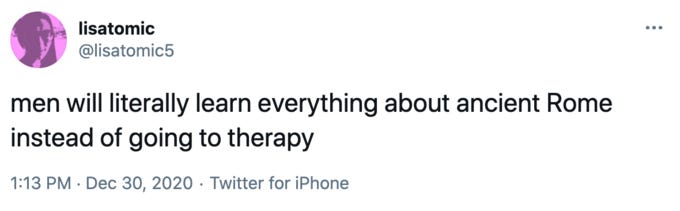
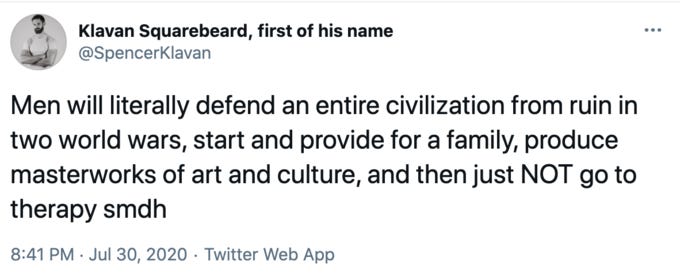
Humanity has always sought distractions, a way to focus our attention somewhere more enjoyable, to help us get to a happier place. It’s just that, pre-phone and social networks, it was more likely that we’d eventually find our way back to address the hard stuff. Leisure, entertainment, distractions were just that: Relief from the default mode of having to deal with a hard life.
Now, though, “distracted” is the default mode and the world around us is being gamified to keep us there so media and tech companies keep the cash flowing in.
This year I want to make a focused effort to “opt out” more, to force myself into the quiet room, to find the value in - well - sitting in my metaphorical chamber, contemplating. I want to practice living with that idleness, to give in to the boredom and let my mind wander.
At the same time, I will work on my focus and create ways to give myself longer stretches of unbroken time to go deeper, whether that’s reading harder books (hello Cormac McCarthy), going back to intellectually challenge stuff (finally finishing the readings from the Greeks) or do more creative work (writing, guitar, coding, drawing). I’m going to work with my hands more (bike mechanic stuff, cooking). And, finally, more volunteering to get out of my own head.
I’ll know things are going in the right direction when I’m looking forward to the silent writing exercises, when I can sit with myself without getting too antsy, when I don’t want to smash the donut in front of me.
Script critique: The line obviously carries double meaning. He’s in rehab to do some work on himself, so that’s where the effort should be going. But, it also works well on a more obvious level. The work to be done is NOT literal, it’s a distraction from the important stuff. The line is a little heavy handed, but it works.
I will start another company rather than seeing a therapist.
Let's try to see if we can get to a place where books beat clicks!