

This is not a political or partisan newsletter, but sometimes we have to acknowledge the role political leaders play. For better or worse, the rest of society takes cues from our political leadership.
I like to think I’m writing to folks who work in business, are team managers, group leaders, and maybe even a few CEO’s and presidents. You know, workaday leaders.
Most people who like a job want to get better at it. Me too. It’s enjoyable to learn how to come up with better strategies, how to keep the team aligned, how to get better results, communicating effectively, keeping everyone motivated, etc.
So, here I share articles, interviews and ideas about how to polish skills, bring new techniques to the table in the interest of, hopefully, going from “adequate” to “great” or at least “better.”
If you’re moderately online there’s no shortage of leadership advice. All the discussion assumes you have the basics covered, so those are rarely mentioned. Plus, the “basics” are boring to write about.
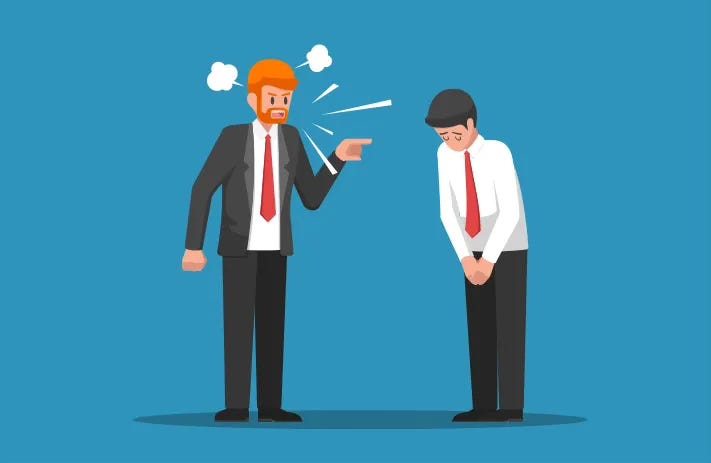
Nobody focuses on bad leadership in the wild.
Maybe we’ve been lulled into complacency in our culture by having enough “pretty good” leaders around us, at work, in our churches, in parts of our government that we’ve forgotten what actual poor leadership really looks like.
We’re getting lots of examples of what weak, compromised, bad-faith leadership looks like. As you’re scrolling through your feed and your inbox, reading about what’s going on in Washington, New York, or your state capital, it’s hard to miss. It’s neither a red or blue problem.
Only hard-core partisans are jumping for joy at the political leaders we’ve got right now. The quiet, responsible middle, those of us who are just trying to get our day-job done, find it much easier to focus on what’s in front of us, where we can actually make a difference in the world.
We shouldn’t look away. We have to be critical.
We should take poor leadership in politics seriously. As bad as some of the examples are, we can all learn something about the leadership we shouldn’t accept. Or, at the very least, we can use them as negative examples: How not to lead.
Want a reminder on how to improve your game as a leader at work? Do your own evaluation of our political leaders, and then probably do the opposite.
Honesty: Can you believe what the leader is saying? Leaders can’t always be 100% transparent (to protect plans, privacy, security) but you have to believe you’re getting the best info that’s shareable.
Trust: Will they actually do what they say they’re going to do? Or, are they telling you what you want to hear.
Higher Purpose: Can they communicate a higher purpose for the work of the team? Is there a motivating purpose for the effort? Are they able to answer the question: Why are we doing all this work?
Power: Are they over-using their position power? Leaning on it too much? Do they seem to take pleasure in wielding it for personal gain? Or, do they share power via delegation, collaboration, trust.
Good Faith: Do you believe their motives? Are they driving projects and policies for good/right/values-aligned reasons. Or, is it clear they’re doing it cynically, to get or maintain power or status?
Vision: Do they have a vision that they can share with the team, even a somewhat clear articulation of a future destination? Or, are they inconsistent about the plan.
Future focused: Are they focused on the future, building towards something? Or, focused on the past and the what didn’t work out well?
Courage: Are they willing to make the hard decisions? Are they willing to be candid? Or, are they too concerned about preserving their own position and power?
Accountable: Will they own up when their plans didn’t deliver? Or, will they deny and defer or blame it on someone else?
Optimism vs Fear: Are they maintaining urgency by focusing on opportunities and a better future? What are they doing to create calm, focus, and clarity. Or, are they intentionally building fear, doubt and worry in the team as a means of holding power?
Perspective: Can they maintain a healthy, honest perspective? Or, do they catastrophize when things are bad, oversell it when it’s fine?
Outcomes: Are they clear about the outcomes that would signify success or progress? Can they communicate why some outcomes are better than others? Or, are they positioning themselves as the sole arbiter of good or bad results?
It’s easy to be cynical about our political leaders at the county, state, and national level. They’re working inside organizational systems - policies, cultural norms, implicit/explicit incentives, rules, laws - they can’t significantly impact and a system that often works against the public, common good.
We mostly view them in a mediated, filtered way. That is, through TV, blog posts, reels, radio, news, Reddit. The media we swim in can, itself, make leaders seem disposable, swipeable, dislikable. We see memes, snippets, stage-managed photo opps, gaggles. The media needs conflict to keep viewers watching or clicking, so it forces an either/or, them/us, good/bad framing that collapses nuance and depth. It’s easy to stop listening. It’s hard to be nuanced, thoughtful, long-term oriented, when you’ve got about 3 seconds of time but that’s what we should be expecting from them.
When we go to work, we don’t have those same constraints. We can be (we should be) better than the leadership we see via the media. (We definitely need better media committed to the public interest, but that’s another post)
Meanwhile, let’s learn from the bad leaders how to be good leaders in our communities.
That’s a good, positive step we can all take right now.
Jim, there’s so much bad behavior out there, I can’t tell any more if it’s modeled from the top down or bottom up. Feels like a cycle. Hope we find our way back