

In my professional life, I am in the middle of things, somewhere between “finishing” the work of my company Fahren and getting started on whatever comes next. I’ve got a lot of work to do in the meantime: Completing some projects, admin and bookkeeping work, some relationships to focus on. It’s going to keep me busy for a while, which is good, because the work to figure out what comes next will be its own project.
Meanwhile, i’m in between things, as they say. Or, as Steelers Wheel would say, “stuck in the middle”.
It’s a confusing time (on purpose and in a good way). I put myself here and, luckily for me, Mr Blonde isn’t running the show.
I’ve been reading Transitions: Making Sense of Life’s Changes, a beautifully written, time-tested book that feels like it was written exactly for me1. It’s precisely the right book at the right time. It lays out a deceptively simple framework for understanding major transitions in life, at work, in the world. It also provides an enormous amount of nuanced discussion about what makes major life/work transitions so tricky: It’s all about the inner game of consciously moving from one phase/place in your life to another.
The whole book is worth a read, but the framework for understanding transitions (not synonymous with “changes”, by the way) is worth touching on, briefly. Not surprisingly, there’s a “beginning” a “middle” and an “end”. But, his framework places them in semi-surprising order: Endings, middle, new beginnings.
Endings - Finding closure and a sense of completion, assessing what has been gained, what has been lost, what you’re going to carry into the future, and what you’re leaving behind. It’s not simply jumping ship, on to the next thing, but bringing it to an “end” that you understand and feel ok about.
New Beginnings - Is what you think it is. It’s the work of charting a new path informed by new, revised or refreshed understanding of yourself after your past. It’s choosing a different direction that makes sense given how you’ve changed - attitudes, values, desires, needs since you started. It’s not simply “what’s next”, the next thing or a simple lane-switch.
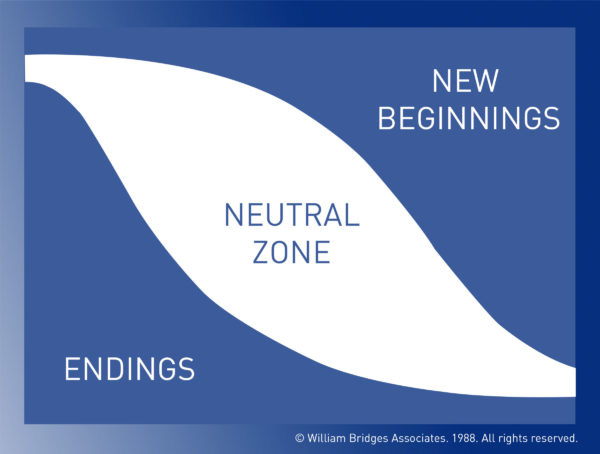
The middle is the hard part. It’s a Neutral Zone, where it gets pretty “woo woo” if you take it seriously. It’s when you have to do the hard work of reflection, processing feelings, understanding (probably in new ways) your values, principles and motivations. It’s where you should slow down or stop, listen to your inner voice and, if you’re open to it, recast the story you tell yourself and others about what you’ve done and where you’re hoping to go.
Neutral means stopping, not “moving”, being in between gears, not going anywhere. This is the hardest part, at least for me. I’m very uncomfortable without a destination, a plan, and guardrails (at least minimal guardrails). I like looking ahead, to move forward, I like to see progress, and I feel competent when I can analyze what’s ahead and build the roadmap to get there. I don’t love surprises.
So the work of putting down the “old” - The plan, the story, the strategies, the goals - creates its own kind of fear. But, committing to, of all things, being “neutral” (or inert, stolid, anodyne, unbiased) is real work for me.
Neutral is not “Adventure”
Coincidentally, i’m reading a couple books that are helpful for different reasons. They are good examples of how the middle part of any story is both where the external adventure and action happens, and where the characters develop and change, internally.
On the Road - I’m re-reading Kerouac’s classic after about 20 years. It’s better in some ways than I remember, but worse in other ways (more on that later). But, the middle part of America - the part he has to get through to get “West” and “Home” is sort of like a supporting character. He’s in “neutral” in the middle part of country, waiting - in small towns, in cars, on buses, for a ride, for Dean - until the next set of “kicks” happen. It’s where Sal is reflecting, understanding, sensing (and getting “sad”) either on the side of the road, or in shitty apartments and bars.
Sherman: Soldier, Realist, American - General Willian Tecumseh Sherman is an incredible character in and of himself, a guy most other guys would relate to: stressed about money, sort of anxious, profoundly depressed, didn’t like office work, career changer, with a hard-to-please but supportive spouse, supremely talented. A man of action like almost no other in American history, he got “stuck.” His period in Atlanta after the incredible campaign to win the city, but before his “March to the Sea” had him and his army in a holding pattern. He was trying to figure out which way to go, quite literally: Go west to and fight “classic” warfare (Pursue the enemy) or go east and march into the future of “Modern” war (destroy the war-making capacity and crush the will of the confederates). He was ambivalent about both; hated the position he was in, but committed to his duty, and itchy to move.
But, as much as those adventures create “change” for the characters, they weren’t the “neutral zone”. There’s a difference between “waiting” and making a choice to be in neutral.
What’s Next? Still Don’t Know
I’ve been talking with trusted colleagues, friends, my informal advisory board, and my family about what comes next. Everyone has been tremendously supportive and patient, but the implication in the question of “what’s next” is still there. I gotta figure it out. They will help, of course, but it’s up to me.
I’m committed to dwelling in the Neutral Zone for a little while longer. I don’t want to do what I’ve done many other times in my past: Move quickly to develop a plan for the next phase. I’m comfortable - for now - as I work on the conclusion of one era and try to wrap that up gracefully. The next thing will get figured out in due time, but only after I dwell in the mess of this middle period.
Bridges was a former college English professor who got burned out and took all his skills at applying myths, themes, story analysis and applied it to real life. He’s a real writer, too. Sharp insights, evocative language, surprising use of literary references, well paced, persuasive.
Sounds like a framework that’s helpful in navigating the middle. The messy middle of careers, life, health, parenting…so little written and shared about the challenges and gifts of this time. Thanks for sharing.
Well written and well said my friend!